
Load-Bearing
The post-scarcity calculation can only count the work that already has a price. Which is exactly the work a machine can take. Nowhere close to the work a society needs.

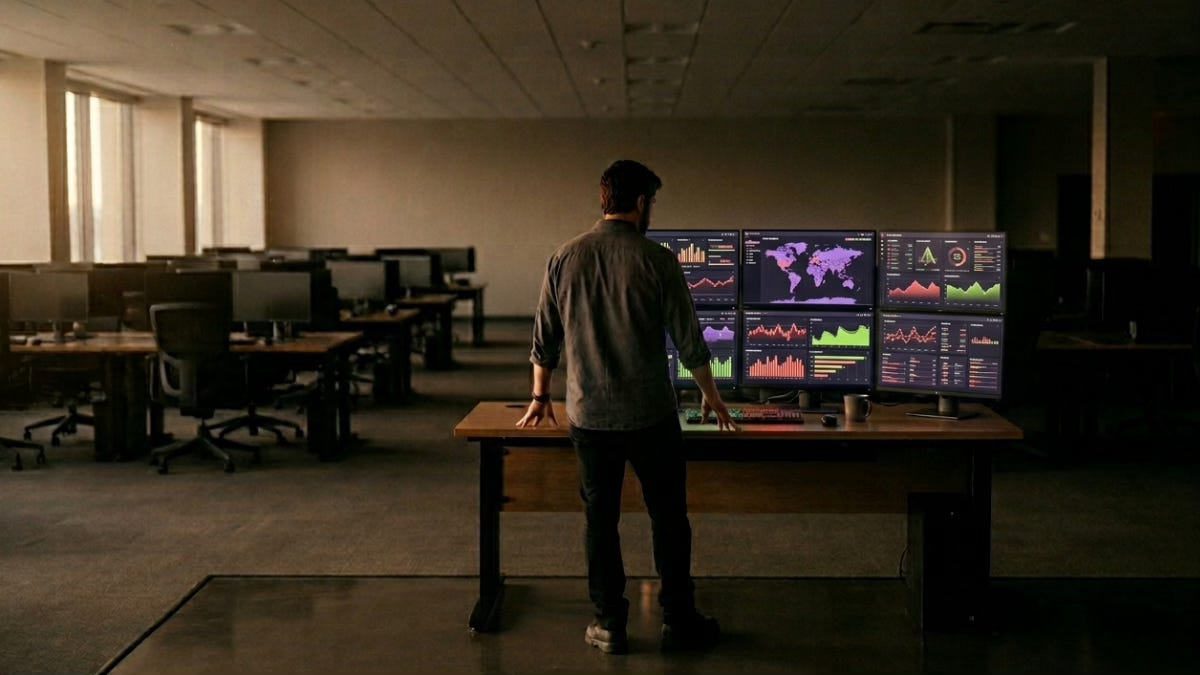
The first real agent builder lands in my hands and I ask it the honest question. Not the demo question. The honest one. Of everything I do in a week, what would give me back the most of myself if I never had to do it again.
I assumed the answer would come from the work. At the time I billed eight hundred dollars an hour as a strategic advisor, and that week carried the kind of cognitive weight that earned the number. So the answer surprised me.
Dinner.
Not the deck. Not the inbox. Not the model pipeline I was being paid to architect. The thing I reached for, on pure instinct, was the Sunday ritual I have never once been paid to perform. The freezer inventory. The kids’ calendars cross-checked against which nights we’ll be at a baseball game grabbing burgers instead of eating at home. The favorite recipe blogs combed for something I’ll like and they’ll eat. The shopping list built precisely enough that I never lose a weeknight to five separate grocery runs.
All of it to survive the witching hours. Back then, I logged off Zoom with ten seconds to context-switch into cooking, got dinner on the table early enough to get the kids down on time, then context-switched again into the deliverable the PE firm needed an hour ago. You cannot make something bake faster than it needs to bake. Not everything can be optimized.
An agent to absorb that work. That was the thing. The agent I could have built to do my market research and hand me a clean digest looked, beside it, like it belonged at the toddler table. If I wanted to actually improve my total output—the real output, the combined paid and unpaid worker I am, that all of us are—the leverage was in the dinner. And the dinner was invisible to every leader in the strategic advisory ecosystem I belonged to.
Two numbers. Same person, same week. Eight hundred an hour for the judgment. Zero for the labor I reached for first.
I had spent a decade telling rooms full of executives that the unit you choose to measure is the whole game. And there I was, handed the most powerful optimization tool of my life, aiming it on pure instinct at the work no market had ever priced. The tool went straight to the labor that was crushing me. The labor that was crushing me and the labor that was paying me were not the same labor. They never had been.
A price is not a measure of worth. It is a measure of visibility.
What carries a number is what we can see. We count it, bill it, chart it, and in the end we hand it to a machine. What carries no number happens anyway. It happens in kitchens and stairwells and the back seats of cars and the middle of too many nights, and it falls out of every ledger we use to decide what a society is made of. Not because it doesn’t matter. Because we never built the instrument that would register it.
Most of the time this is a quiet error. It becomes a loud one the moment we start drawing the map of a world where the priced work is gone.
They understand the pain. They have filed it under necessary.
The mistake nearly everyone makes about the people charting our way out of work is assuming they cannot see the suffering. They can. Peter Diamandis has written the most fully worked-out account of the post-work transition I’ve come across, and the displacement in it is not abstract. It arrives as a young man who studied four years and cannot find work, a forty-five-year-old whose job was automated out from under him, a generation locked out of the contract its parents took for granted. He names the valley of desperation. He knows it bites. He has simply already priced it—as short-term, as the cost of passage, as the necessary pain on the way to a better world. The argument does not fail because its author is callous. It fails on a blindness more structural than feeling, and a careful, sympathetic mind is exactly where that kind of blindness is hardest to find.
He calls it Universal High Income, and on its own terms the premise holds. AI eats the priced economy faster than any wave before it. A floor of three thousand dollars a month holds people up. Then robotics and models drive the marginal cost of nearly everything toward zero, until the same check buys an abundant life. The check never changes. The world gets cheap.
I have written before about how we ended up here—how one discipline built AI and one discipline funded it, and the technology we got was shaped by what that room could see. That essay was about the blindness in the build. This one is about what the same blindness lets you believe once the thing is built: that the pain biting down on real people this year is the temporary toll of a future arriving on schedule. The room that could not see the labor cannot see why its map of that future is missing a continent.
So look at what the plan is built to count. Its funding mechanism—the Automation Dividend, his name for a public cut of automation’s gains—is pegged to the displaced full-time-equivalent job, because a job is a thing with a number on it. The categories slated to collapse in price—transportation, housing, healthcare, food, education, energy—are each recast as a delivery problem with a robot on the far end. Healthcare becomes diagnostics. Food becomes robotic agriculture. The whole apparatus runs on inputs that were already priced, because those are the only inputs it has a column for.
And here the engineering matters, because the demonetization story is not equally true across those categories, and the difference is technical, not rhetorical. Diagnostics, navigation, tutoring, photography—the things that have already demonetized—all rode on a corpus that already existed. We have been feeding the internet since the nineties. The data was sitting there, legible, waiting to be modeled. Embodied care has no such corpus. There is no archive of the ten thousand micro-judgments inside changing a diaper, settling a frightened child, bathing a parent who no longer recognizes the room. To build a model that could do it, you would first have to capture the data, and the only place that data lives is inside the homes and on the bodies of the people performing the labor. You would have to strap the sensors to the mother. Which means the work cannot be automated until it has first been made visible—and making it visible is the precise thing this system has not yet learned to do. The blindness is recursive. You cannot price what you cannot see, you cannot automate what you cannot capture, and you cannot capture what you have defined as outside the economy. “No robot is changing that diaper” is not my guess about robotics timelines. It is a structural consequence of the same accounting error, and it will hold for a long time, in every case that is not already legible to capital—the factory, the warehouse, the retail floor—and will not reach the home until someone in the room has lived in it.
Now look for what isn’t there. Three phases, five thousand careful words, and the labor of one human being tending another never appears as itself. Not the diaper. Not the bath. Not the meal that is also an apology, the homework at the kitchen table, the friend held together over the phone at two in the morning. The labor that has always run beneath the priced economy, holding it up the way a foundation holds up a house, is simply absent from the math that proposes to replace it and fund its replacement in the same breath.
It cannot be eliminated, for the reason the engineering just made plain. It cannot be taxed; nobody is paying for the unpriced share of it now. It cannot be counted; it has no price. It falls out of the ledger at every door at once, and not because the man writing it is careless. Because the unit he is counting in was never able to hold it.
The cheapest way to never pay for work is to convince the worker it’s a calling.
“Do what you love” is the most expensive advice in circulation, and it’s the worker who pays. No one covers full freight on what you would do for free. Rename a job a vocation, a duty, a privilege, a source of meaning, and you have built the most efficient price-suppression engine ever devised. The work still gets done. It just comes off the books, performed by someone taught that asking to be paid for it would cheapen the very thing.
We have run this experiment already. At scale, for centuries, on half the human race. The labor of the household and the labor of care were ruled not work but love, not a job but a nature, and that ruling was exactly what kept them free. It was not an oversight in the accounting. When the national income statistics were built, the unpaid work that keeps human beings alive and upright was drawn deliberately outside the border of what counts as the economy. Marilyn Waring proved it decades ago, from inside government, and was largely told it didn’t signify. A system that could measure a weapons plant’s output to the decimal and not the raising of the child that plant might one day kill. The border was a decision. It is still the border. And we are about to pour a civilization on top of it.
Same hour. Same body. One of them invoiced.
To do the traveling strategic work, I had to pump. Eight times a day, on a clock that bent for nothing, because that was the condition that let me keep the billable work and keep giving my son the benefits only that labor gives him. So I found phone booths. Supply closets. Any door that would shut. I managed the engorgement and the letdown and the count of the minutes while a meeting ran long, while the client worked through the exact wording of the phrase that would sit at the top of a single slide in a board update. The paid economy ran directly on top of the unpaid one. One hour, one body, and only one of the two on any invoice. The one that never touched it was the one without which none of the rest could happen.
There is the error, in the flesh. The paid work rode on the unpaid work. The ledger saw the rider, billed for the rider, and never once saw the road.
The labor we agree to call a nature instead of a job is not only the labor of mothers.
I watched it kill a system once.
There was an engineer who got in before everyone. Every morning, ahead of the first user, he cleaned up what the overnight jobs had wrecked, reconciled the data that would not reconcile, caught the breakage before it reached the people whose entire day ran on that system being right. He did it because the good ones cannot do otherwise. Every great engineer I have known holds the thing they built the way a painter holds a canvas, the way a writer holds a book—they want it clean, they want it smooth, they want the person on the other side to meet no seam. That pride is real, and it is precisely what an organization learns to run on for free. It is the same forever war between the architects who want it built right and the operators who want it out the door, the one that never settles the question of what the minimum viable product actually is. He had been absorbing that tension at dawn for so long that nobody remembered it was being absorbed. The system was simply reliable. That was simply its nature.
Which made him a cost. When it came time to find costs to cut, he was legible the only way costs are legible, as a salary and never as a function. The work had no ticket, no standup line, no entry in any record built to measure who contributed. So he was invisible in precisely the way that gets a person cut. They cut him.
For weeks nobody tied anything to anything. Then the system everyone had trusted without thinking quietly stopped being usable, and not one person could say why, because not one person had ever known what he did at dawn. The knowledge walked out with the man. His labor turned visible the only way invisible labor ever does. As a hole. After the fact. Too late. You cannot count, tax, or replace what you were never able to see. You learn it was load-bearing by removing it and watching what falls.
Then they send everyone to look for meaning.
The careful future does not end at the check. It knows a life without work is not the same as a life with meaning, so it closes the way these arguments always close. By sending people off to find purpose. In national service. In creativity. In community. In the slow, unmeasured work of tending the people in front of them.
Look at what the instinct reaches for, and look at what it steps over. Handed the optimization tool and asked what to take off my plate first, I surfaced the unpriced labor, because I am the one carrying it and you cannot fail to see what is crushing you. The plan, sent to find meaning for the displaced, reaches for service and art and exploration, and the labor of care and kin-keeping is nowhere on the list. Not rejected. Not weighed and set aside. Simply never the thing reached for, folded so far underneath community and purpose that it never surfaces under its own name. The same labor, surfaced by one instinct and buried by the other, and the only difference between them is who has ever had to do it.
Because whichever item you pick off that list, you are pointing at unpriced labor. Service is unpaid. Community is unpaid. The care folded invisibly inside both has gone unpaid the longest of all. They are prescribing, as the cure for a life without meaning, the precise category of work their plan could not count, could not tax, and could not pay for. The work they cannot see is the work they reach for the instant they need to hand a person a reason to get up in the morning. They have reinvented the labor of love. They are about to scale it to everyone. And they are calling it the future.
The cage one half of the world was kept inside for centuries is being repainted and offered to the other half as a garden. Offered by people describing the room from the doorway. People who have never once been asked to live in it.
✦ ✦ ✦
And now for my closing ritual: Thesis & Texture
Each week, I end with two book recommendations. One that sharpens how we think about technology, capital, and power. Another that holds what systems can't: the texture of being human.
The Thesis: Who Cooked Adam Smith’s Dinner? by Katrine Marcal. Adam Smith, the "father of modern economics," explained that we get our dinner not from the butcher's benevolence but from his self-interest, and left out the person who actually cooked it. His mother did, and the model he founded has never had a column for her. Marçal, a Swedish journalist with a rare gift for making economics land, follows "economic man" from Smith to the present and shows what an entire discipline distorts when it is built around the priced transaction and blind to the unpaid one keeping it alive. Short, fierce, and very funny about a subject that usually isn't. The kind of book that rearranges what you thought was settled.
The Texture: Small Things Like These by Claire Keegan. The novella runs barely a hundred pages and not one of them is loose. Bill Furlong, a coal and timber merchant in a small Irish town in the weeks before Christmas 1985, makes a delivery to the local convent and finds something there he cannot quite walk away from. What follows is the quietest kind of suspense, the question of what an ordinary, decent man will do once he has seen what his whole town has agreed not to see. Booker-shortlisted, later filmed with Cillian Murphy, and so precisely made that it holds more in its silences than most novels manage in four hundred pages. Read it in a single sitting and carry it much longer.
The distinction between price and worth, especially through the dinner example, is so sharp because it exposes the part of the AI productivity conversation we keep politely stepping around. We talk so much about automating paid work, while the truly load-bearing labor is sitting underneath the whole system, unpaid, unseen, and apparently holding civilization together with a grocery list and mild resentment. Such a powerful piece. 🩷🦩
Very thought provoking. Ironically the people who are accustomed to doing the invisible labors, will probably be doing the invisible labors of making sense of the gap and making the missing pieces explicit.