
The Hidden Geometry of High-Performing Teams
Why Diamond-shaped precision and POD-shaped breadth create the Zipper Zone—the structural alignment that lets teams absorb complexity, move with coherence, and turn AI from potential into results.


There’s a moment in every AI transformation where the real obstacle finally surfaces. And it’s almost never the model. The algorithms are good enough. The data is workable. The tooling improves monthly. The real challenge is ironically far more human and far more systemic: the organization cannot move as one. Handoffs create friction. Ownership blurs. And the seams between disciplines pull apart just when intelligence needs them to hold together.
When I first introduced The Zipper Zone™, I argued that AI doesn’t stumble over technology—it stumbles over alignment. Velocity without integration collapses into chaos. Integration without velocity hardens into gridlock. Both conditions create more risk for AI than almost any model misstep ever could. But this past year, working deeply with companies trying to adopt AI responsibly while modernizing their operating models, has only sharpened that idea. That the Zipper Zone isn’t an abstract concept or an organizational aspiration. It’s a team-level condition. And it rises or falls inside the smallest meaningful unit of work: the team or ‘POD’.
A POD (short for a Product-Oriented Delivery team) is not an Agile formality or a tech staffing convenience. It’s a micro-organization. A deliberately designed, cross-functional, end-to-end problem-solving unit that owns a real customer outcome. A true POD integrates product judgment, engineering depth, UX or service design, data insight, quality rigor, and delivery discipline. When designed well, it’s the modern equivalent of an elite task force: cohesive, interdisciplinary, highly aligned, and structurally capable of converting intent into impact.
When a POD is composed correctly, it becomes a stabilizing force inside the enterprise. It collapses decision latency, reduces coordination overhead, and accelerates feedback loops. It becomes the place where the enterprise spine gains strength. When it doesn’t exist yet or is composed poorly, all the classic anti-progress patterns emerge: chaos, gridlock, and the corporate swamp.
Before exploring what differentiates a high-performing POD from a dysfunctional one, it’s worth a quick re-grounding in the original Zipper Zone diagnostic that started this thinking.
Every team lives at the intersection of two forces—how quickly it can move, and how well it can stay aligned. When you chart those forces, this landscape appears:
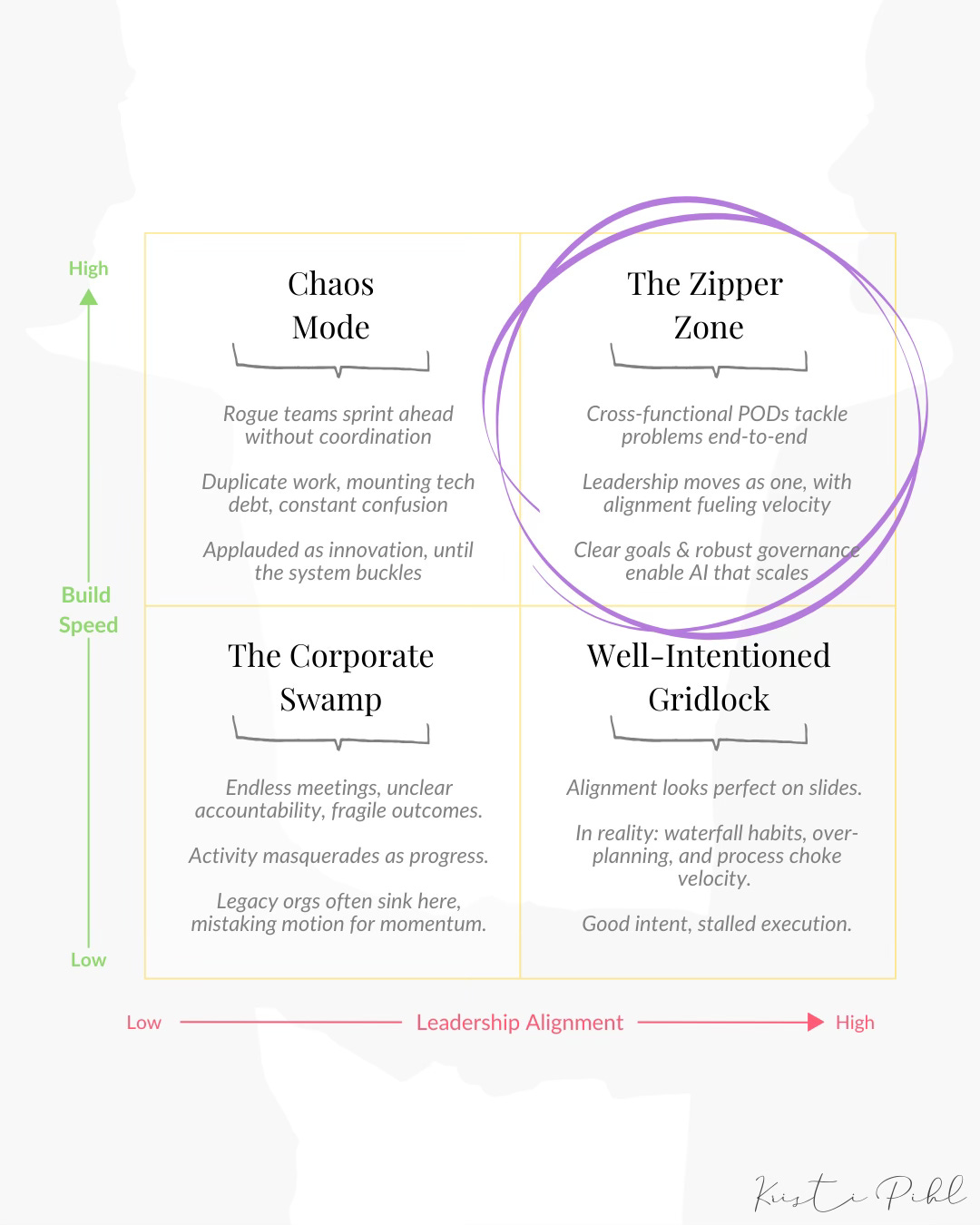
Most companies drift into predictable trouble patterns. “Chaos Mode” rewards speed at the cost of integration. “Well-Intentioned Gridlock” prioritizes consensus at the cost of movement. “The Corporate Swamp” drowns teams in process without outcomes. Only the fourth quadrant—the Zipper Zone—produces the structural conditions where AI can land safely and scale sustainably. But what I see over and over is that the Zipper Zone does not emerge from governance or leadership edict. It emerges from the structure of the teams doing the work—their composition and fundamental ways of working together.
And that base structure is deeply influenced by something I learned early in my own career—something that reshaped how I think about what a “real” high-performing team looks like.
Years ago, before the era of mega-firms and global consolidations, there was a 500-person strategic tech advisory firm called Diamond Management & Technology Consultants headquartered in Chicago. Diamond was small but legendary. They were known for something unusual in the industry: a consistent ability to bring in small, elite, cross-functional “SWAT teams” that delivered results on the hardest problems. The joke inside the industry was simple: you hire McKinsey for the ideas, Accenture for the army of doers, and Diamond for the leadership required to make the first two actually work. I was blessed to start my career there. Being educated on projects as the bottom point of those ‘Diamonds’—delivering real transformational impact at industry-leading organizations—was better than any MBA or master’s program could ever deliver.
Diamond’s secret sauce wasn’t methodology. It wasn’t a framework or a brand promise. At its core, it was a team structure—the Diamond itself. Each team was intentionally built to navigate complexity. Each was shaped like its namesake: sharp at the top, wide in the middle, pointed at the base. A senior leader who could see the full system. Two or three mid-level professionals with the judgment and autonomy to drive major workstreams. And one brilliant junior talent who brought raw horsepower, curiosity, pattern recognition, and analytical range.
This structure was not an accident. It was the organizational embodiment of the firm’s entire go-to-market strategy: leverage. Not in the cost-savings sense, but in the intellectual sense. Diamond’s teams were designed to be disproportionately effective—not big, not bloated, but precise, smart, fast. And they were precise because they were composed intentionally: experience balanced with experimentation, strategic clarity mixed with operational grit, energy paired with wisdom.
Now, we return to the needs of modern organizations and product delivery operations.
In my own advisory work, I’ve found that the Diamond structure maps uncannily well onto the needs of a modern POD. While Diamonds formed the basic unit of the firm, the modern POD forms the basic building block of the entire agile release train or set of product development teams in your technology organization. In fact, when you fuse the two—the cross-functional completeness of a POD with the seniority geometry of a Diamond team—you get the most capable small team structure I’ve seen to unlock success in the AI era.
A senior anchor brings systems thinking and coherence.
Mid-level leaders bring craft mastery and operational rhythm.
A junior talent brings range, curiosity, and the native ability to use AI tools to accelerate insight.
And the cross-functional POD capabilities ensure that decisions, design, code, data, and testing all live inside one tight loop.
This hybrid structure—Diamond leverage inside a modern POD—actually produces the Zipper Zone. It’s the place where the enterprise stops behaving like a collection of disconnected functions and starts behaving like an intelligent system.
Why does this matter so much now? Because AI magnifies whatever structure it enters. If the underlying team structure is misaligned, AI accelerates dysfunction. If the team is balanced and self-sufficient, AI accelerates excellence. In misaligned teams, AI creates noise. In well-structured teams, AI creates lift. The distinction is structural, not technical.
This is why I now tell every executive the same thing: don’t begin your AI journey with a pilot or a strategy deck. Begin with a team. One POD. Designed with intention. Pointed at something big and challenging that matters. Staff it with the right mix of seniority, discipline, and cross-functional expertise. Anchored by someone who sees the system. Powered by mid-level leaders who can carry meaningful responsibility. Fueled by junior talent who can wield AI tools with sophistication and imagination.
If that POD works, it will generate the Zipper Zone inside its own walls quickly. When that happens, the rest of the organization can learn and scale around it. That’s when real enterprise transformation begins to take root.
In the end, the Zipper Zone isn’t a quadrant or a metaphor. Think of it more like the foundational Lego block. It’s a structural condition that emerges when teams are given high-impact, clearly defined scope and designed to carry complexity without breaking. Yes, AI exposes every seam. But it also rewards every place where the seams have been reinforced with intelligence, intention, and the right composition of people and authority.
And in that sense, the future of AI-driven enterprise work is not about bigger strategies or larger programs. It’s about smaller teams, built with precision, capable of moving with shared intent. It’s about PODs cut like Diamonds finding the Zipper Zone.