
The Part I Left Out
Thirty-one essays about judgment and this technology, and I never told you what I was about to do about it.

A year ago I was sitting in the red sandstone at Red Rocks, watching my niece graduate from high school. Colorado graduates are spoiled. They get to walk across arguably the most famous stage in America, the same stone where everyone from the Beatles onward has played, and most of them are seventeen and have no idea.
I spent the morning listening to her and her friends quietly demolish their chosen student speaker. His crime, in their telling, was that he had won the slot mostly on a comfort with ChatGPT that the rest of them found unremarkable and a little embarrassing. They were not impressed. They had already metabolized the tool, sorted it, and moved on to judging what you actually did with it.
I had spent the entire day before on back-to-back calls, explaining to clients for roughly the ten-thousandth time that month why I could build the thing they were asking for but it would not get them the result they wanted.
That is what being an actual expert in this technology has felt like for a couple of years. We used to spend our energy beating back the overpromises coming from the product companies. Then the buyers started hallucinating too, and the job quietly became managing other people’s fantasies about a technology I understood better than almost anyone in the room. You know this story. I do not need to tell it.
What I could not stop thinking about, sitting in those rocks, was that the teenagers around me were already further along than my clients. Nobody had briefed them. They had grown up inside it, and they understood what it was, what it wasn’t, and roughly where it was headed with a clarity the people paying for my time were spending fortunes trying to fake.
The following Monday I opened my calendar. The contacts to follow up with, the campaigns I was supposed to be running to feed the practice. And my body would not cooperate. I could not make myself care.
For months now I have been writing around this. Every week in this space I argue some version of the same thing. The unit that matters is the decision, not the capability. Judgment has to stay with a human who is accountable for what happens. The most important thing you can build into any system is the place where a person can look at the optimized path and refuse it.
That Monday I refused mine.
I would rather help a thousand teenagers understand Newton’s laws than help one more company make money with this technology.
It took me a long time to say that plainly, because it is not noble. It is a preference. And once I admitted it was a preference, I had to decide whether I was going to behave like someone who meant it.
I want to be precise about one thing, because it is the part people too often get wrong. I never lost my love for the technology itself. I have been a first adopter and a first builder my whole career, through a long string of these waves, and I am as curious now as I have ever been. If anything, the thing I am most excited about isn’t even this current wave. It’s quantum. What I lost patience with was never the science. It was the apparatus that has grown up around it, the machine that turns wonder into a pitch deck. I have always aimed my frustration at the extraction, never at the thing being extracted. That distinction is the entire reason I can leave the work without leaving the field.
This is not the first time I have done this.
In 2020, sick and quarantined away from my husband and our three-year-old, I founded a company built entirely around the thing that has grounded me my whole life. Books. I have been an avid reader since I was a little girl in Iowa hiding in a treehouse with a flashlight. Twigge was what happened when I asked what it would look like to bring my whole self to a mission instead of renting out only the parts of me someone else found useful.
I come from two generations of people who made the same move. My grandfather left a steady C-suite role to build an industrial refrigeration business. My father, an eye doctor, could not get the volume discounts the large players got, so he built a national distribution company to fix it. I grew up understanding employment as one option among several, never as the ground beneath my feet.
I have never really had a career. I have had a portfolio.
I do not write advisory content and I do not do personal-growth posts, so take this as my one exception. If you put every egg in the single basket of one employer, you have handed your agency to a party whose interests are not yours. In 2026 that gets more dangerous, not less. The only durable loyalty is to yourself, and you can only afford it if you have built a life that can absorb a no.
Agency is not a temperament. It is infrastructure.
Which is the part most people leave out, so I will say it directly. The reason I can refuse the optimized path is that my husband and I spent the last twenty years engineering the ability to. We kept our needs small and our margin large. We made the boring choices long before we knew which dramatic one they would eventually pay for. I still drive a 2013 Subaru, and not because I have to.
I am not brave. I built a life in which this did not have to be brave. You construct agency on purpose, in the quiet years, so it is there in the loud one.
So here is the loud one.
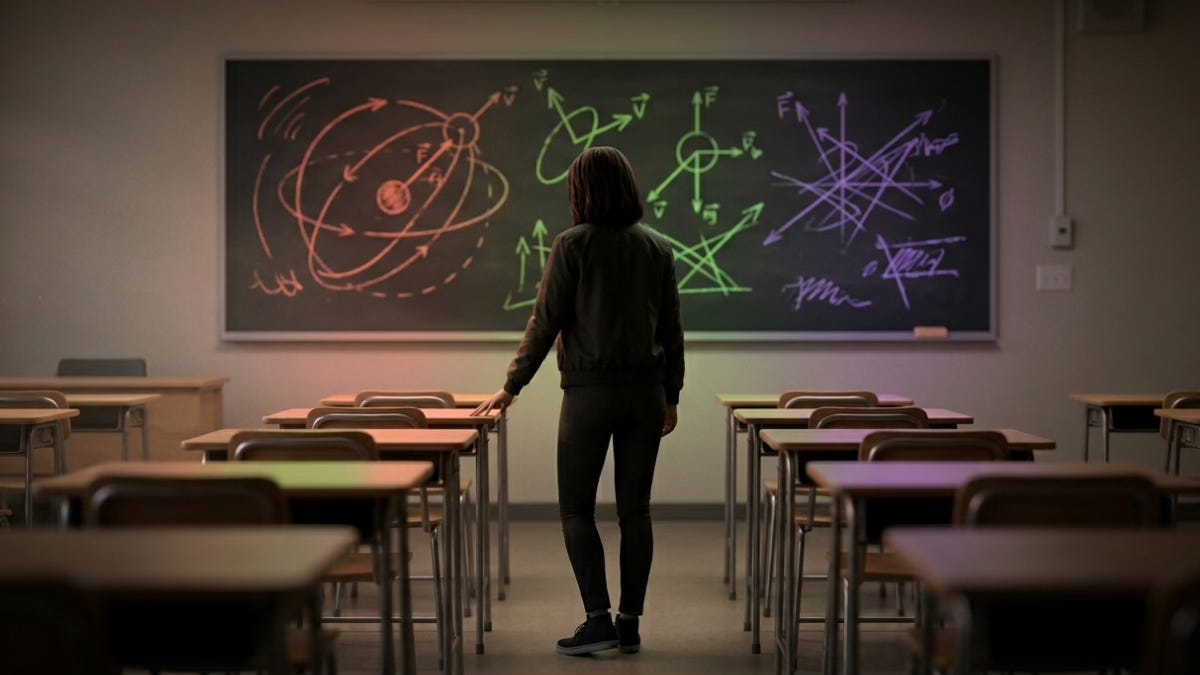
This fall I am going to teach upper school science. I have accepted the position. By day I will be a physics teacher. The writing continues. The angel investing continues. But the leg of the portfolio that carries the most weight is changing, and it is changing toward a classroom. If you want to understand why a classroom, you have to know something about the rooms I have spent my career in.
I have spent most of my life as the only one in the room.
The only engineering major in my sorority. One of a handful of women in my undergraduate engineering classes, fewer still who had grown up speaking English. Later, at the tables where the real decisions got made, almost always the only woman, and I got good enough at making everyone comfortable with that to embarrass myself in hindsight. Early on, I once tried to explain to colleagues how hard it was to leave a newborn at home and fly across the country every week. The hardest work-life balance problem the men beside me were solving was getting their wives to submit expense reports on time. We were not in the same room, even though we were in the same room.
I do not tell that for sympathy. I tell it because I finally know what I want to do with having survived it.
STEM is STEM.
Here is what I actually believe, underneath all of it.
STEM has been quietly fused, in the public mind, with extraction. With the IPOs of the apocalypse, the ones lining up right now to convert the wonder of the last decade into some of the largest private fortunes in human history. The cost of that fusion is that the wonder itself goes down with the spectacle. A generation is learning to associate science with the people strip-mining it, and turning away from the actual thing, which was never about enriching a fraction of the population. It was about understanding the world well enough to make it better for the people living in it.
That link has to be broken. The IPOs of the apocalypse are not STEM. STEM is STEM. It is Newton’s laws and orbital mechanics and the reason a student who understands them can look at a plan to put data centers in space and tell you in about a minute whether it is engineering or theater. That discernment is judgment. It starts in a classroom, and we are at risk of losing it across an entire generation at precisely the moment we need it most.
So I am going to the source. Not to comment on the next generation from a distance, but to stand in the room with them and defend the thing I have loved my whole life from the people currently defining it down to a stock price.
I am not going anywhere. I will be here every week. I will just be writing from inside a different room now, the one where the systems many of you are building meet the minds that will have to live with them.
I suspect that is where the next decade of my thinking actually lives.
✦ ✦ ✦
Congrats Kristi! It sounds like a great way to use your skills and talents!
I love this!